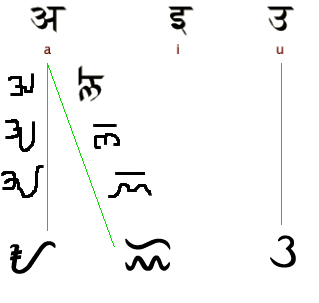
I was viewing some beautiful Caddoan artwork yesterday, and picked out some visual motifs that seem to repeat themselves. Before long, I had visited Wikipedia's page on the Caddo language, and I quickly scrawled out a proof of concept for a Caddo alphabet.
Why should Caddo languages have their own alphabet? Why not just use Latin?
Because your alphabet says something about your culture. If your language has sounds that Latin does not approximate, then custom letters are needed. (For example, English could use a letter like Thorn!)
A writing system crafted to complement your culture can be an artistic outlet.
More importantly, though: if your culture is distinct from American culture, and it has a language worth preserving as a vehicle for that culture, then a home-built writing system is one of many ways to promote that culture.
Here's my proof-of-concept Caddoan. The shapes were taken from Jeri Redcorn's sublime pottery designs, as well as historical photographs of Caddo art. I also admit a passing influence from Baybayin, since a few of its letter shapes are universal and beautiful, and correspond to some of the Caddo shapes I use. I adapted three.
Friday, June 1, 2012
Thursday, May 31, 2012
Ye Olde "Bringe Back Thorn" Post
abcdefghijklmnopqrstuvwxyzþæŋᛟчщə
I'm seeing this sort of thing show up every now and then on the web, and I suppose that means it's time for a grassroots effort to update English by backtracking some.
þ
That's thorn, and it represents 'th' in English. I've used it from time to time over the past 20 years, and always loved it and its brother, edh (ð). I'd love to see either one, or both, make more of a comeback, so I'm going to go out of my way to use them more often. Probably, I'll just settle on one of them.
æ, @
That's ash, which represents the "short a" sound, like the way we say "cat" and "hat" in the USA. Next to it is the 'at' sign, available on every English keyboard. I'd like for ash to replace "a" when it's short, but it's not æs easy to write æs just an "a". So I would fudge a bit, and use @ instead. I only wish the @ sign in this font were a bit smaller, though.
ŋ
And that is eng, invented by Alexander Gill the Elder in 1619, and used by Benjamin Franklin. I've used this baby quite consistently for 20 years, because of the -ing ending of so many of our words. In fact, I use 'dotted' eng to represent /ing/. I think it is one of the best thiŋs since sliced bread.
ᛟ
That little guy is Odal or Oþal, a Germanic rune. It stands for the long-o sound. Assuming we ever get this far, we might need a rounded version of oþal when we split the letter o into its short and long forms.
ч
щ
From Cyrillic, ч for ch, and щ for shch, but here used for just sh.
ə
@nd l@st, bət not least, ðə lettər ðey're still teaчiŋ in grade sчool -- sчwa -- щould be promᛟtəd @nd replace ðə шort u.
Anyone have other suggestions?
There's my list, for now.
abcdefghijklmnopqrstuvwxyzþæŋᛟчщə
I'm seeing this sort of thing show up every now and then on the web, and I suppose that means it's time for a grassroots effort to update English by backtracking some.
þ
That's thorn, and it represents 'th' in English. I've used it from time to time over the past 20 years, and always loved it and its brother, edh (ð). I'd love to see either one, or both, make more of a comeback, so I'm going to go out of my way to use them more often. Probably, I'll just settle on one of them.
æ, @
That's ash, which represents the "short a" sound, like the way we say "cat" and "hat" in the USA. Next to it is the 'at' sign, available on every English keyboard. I'd like for ash to replace "a" when it's short, but it's not æs easy to write æs just an "a". So I would fudge a bit, and use @ instead. I only wish the @ sign in this font were a bit smaller, though.
ŋ
And that is eng, invented by Alexander Gill the Elder in 1619, and used by Benjamin Franklin. I've used this baby quite consistently for 20 years, because of the -ing ending of so many of our words. In fact, I use 'dotted' eng to represent /ing/. I think it is one of the best thiŋs since sliced bread.
ᛟ
That little guy is Odal or Oþal, a Germanic rune. It stands for the long-o sound. Assuming we ever get this far, we might need a rounded version of oþal when we split the letter o into its short and long forms.
ч
щ
From Cyrillic, ч for ch, and щ for shch, but here used for just sh.
ə
@nd l@st, bət not least, ðə lettər ðey're still teaчiŋ in grade sчool -- sчwa -- щould be promᛟtəd @nd replace ðə шort u.
Anyone have other suggestions?
There's my list, for now.
abcdefghijklmnopqrstuvwxyzþæŋᛟчщə
Friday, March 16, 2012
Hawaiian orthography goes native
I was browsing images of Hawaiian petroglyphs the other day, and had a thought. We know the Hawaiians created them. We know the Hawaiian language. We know that many of the petroglyphs represent known concepts.
So, why not use those glyphs to derive a Hawaiian writing system? Sounds fun!
I then sat down with the web on my computer and a very thin tourist-friendly guide to the Hawaiian language, and in no time I had a serviceable first draft. I did it by taking the first sound in a word that has a corresponding glyph, and simplifying or stylizing the glyph a bit, and so I had an alphabet.
For example, the fishhook glyph. I forgot its name (it looks a bit like a capital letter J). I used it to represent the first sound in that word.
After that I tried to build a syllabary, because Hawaiian has no consonant clusters at all, but didn't have enough glyphs or words at hand. But anyway, alphabets are an order of magnitude easier to learn.
If I get the time, I will put my alphabet online as a font.
So, why not use those glyphs to derive a Hawaiian writing system? Sounds fun!
I then sat down with the web on my computer and a very thin tourist-friendly guide to the Hawaiian language, and in no time I had a serviceable first draft. I did it by taking the first sound in a word that has a corresponding glyph, and simplifying or stylizing the glyph a bit, and so I had an alphabet.
For example, the fishhook glyph. I forgot its name (it looks a bit like a capital letter J). I used it to represent the first sound in that word.
After that I tried to build a syllabary, because Hawaiian has no consonant clusters at all, but didn't have enough glyphs or words at hand. But anyway, alphabets are an order of magnitude easier to learn.
If I get the time, I will put my alphabet online as a font.
Wednesday, September 7, 2011
What's in a name: Srividya
Names are interesting and educational. One of my co-workers is named Srividya. I thought that /sri/ sounded familiar: to wit, /sri lanka/, "divine island", but I didn't know what /vidya/ meant - sounds like "video" but Indian names are ancient, plus who still with their wits about them would name their kid "divine video"??
So I do what I do when I'm at wit's end: I ask. /Sri/ in this case means abundance, as in 'wealth', or 'a wealth of'. And she said /vidya/ means 'knowledge'.
A little googling gave me more info. Vidya is an epithet of Saraswati, a goddess of knowledge and daughter or consort of Brahma. Makes me think of Athena, the daughter of Zeus.
Now the cognates. PIE is *weid-, to know, whence Englist 'wit'. In Latin, it's videre, whence English 'vision'.
And now you know what I know about the word vidya.
So I do what I do when I'm at wit's end: I ask. /Sri/ in this case means abundance, as in 'wealth', or 'a wealth of'. And she said /vidya/ means 'knowledge'.
A little googling gave me more info. Vidya is an epithet of Saraswati, a goddess of knowledge and daughter or consort of Brahma. Makes me think of Athena, the daughter of Zeus.
Now the cognates. PIE is *weid-, to know, whence Englist 'wit'. In Latin, it's videre, whence English 'vision'.
And now you know what I know about the word vidya.
Tuesday, June 28, 2011
Tuesday, May 31, 2011
Baybayin Expanded
In the past year or two, I've looked at Baybayin and how elegant its letters are, how enjoyable it is to write... but also how truncated it is for English. I've come up with ways to represent R versus D, looked at historical letter-orderings, thought about how to use ancestor scripts (including the Nagari) to split out more vowel sounds, and looked at historical samples of Tagalog to see how certain letter clusters are handled.
Now I want to put it all together. Several times (because I expect to do poorly the first couple times, then get better results as I re-try). To extend Baybayin in ways that do the least harm to it.
I'll be needing to see how others have done it. Anyone have suggestions?
Now I want to put it all together. Several times (because I expect to do poorly the first couple times, then get better results as I re-try). To extend Baybayin in ways that do the least harm to it.
I'll be needing to see how others have done it. Anyone have suggestions?
Thursday, May 5, 2011
HandyWrite - the Ultimate Shorthand System
It's time for an app that understands shorthand. It's time to bring shorthand back.
Check this out:
http://www.alysion.org/handy/handywrite.htm
This guy designed what looks like a near-optimal shorthand system:
1. He started with Gregg shorthand. Note that just using Gregg letters alone you'll speed up your note-taking significantly. The downside is that the notes themselves are often abbreviations, so you have to transcribe soon after you've taken the notes or else it becomes a bit opaque.
2. He extended it to represent the full range of English pronunciation. Now you have 1:1 sound-correspondence to English. You can read back what you wrote years later. i.e. It's a full writing system.
3. He then added a symbology for just 100 of the most common English words. Not at all as extensive as classical shorthand, but all you need is to be able to record notes as fast as they're spoken.
Ok, the best thing about it in my opinion is that it honors and re-uses prior art in simply extending Gregg shorthand. That alone is worth something in my book -- and not just for sentimental reasons: Gregg is a thoughtful and elegant system.
I've jotted down the letter forms, and will be practicing them little by little as I have time. My goal is to be able to record meetings with it.
Actually, my real goal is to write an app that will let me take notes with it.
Check this out:
http://www.alysion.org/handy/handywrite.htm
This guy designed what looks like a near-optimal shorthand system:
1. He started with Gregg shorthand. Note that just using Gregg letters alone you'll speed up your note-taking significantly. The downside is that the notes themselves are often abbreviations, so you have to transcribe soon after you've taken the notes or else it becomes a bit opaque.
2. He extended it to represent the full range of English pronunciation. Now you have 1:1 sound-correspondence to English. You can read back what you wrote years later. i.e. It's a full writing system.
3. He then added a symbology for just 100 of the most common English words. Not at all as extensive as classical shorthand, but all you need is to be able to record notes as fast as they're spoken.
Ok, the best thing about it in my opinion is that it honors and re-uses prior art in simply extending Gregg shorthand. That alone is worth something in my book -- and not just for sentimental reasons: Gregg is a thoughtful and elegant system.
I've jotted down the letter forms, and will be practicing them little by little as I have time. My goal is to be able to record meetings with it.
Actually, my real goal is to write an app that will let me take notes with it.
Friday, May 14, 2010
[Interspel] "Instant English"
As none of you-all know, I am a proponent of Interspel, a proposal by Valerie Yule to standardize the subset of English spelling which even literate native speakers have perpetual problems with. I'll link to Interspel's Wikipedia entry below.
Anyway, I recently heard a comment about how Instant Message English -- I'll call it Instant English -- tends to be far too "cooked down" to be much use beyond vapid grunts. The example given was:
u r, u no (i.e. you are, you know)
It's quite terse. Too terse, too ambiguous beyond very simple replies. However, the principles are sound: remove useless letters. And if the vocabulary grows, perhaps it will grow alongside 20th-Century English Spelling, or even replace some of it.
Hopefully for the better.
Interspel entry in Wikipedia
Anyway, I recently heard a comment about how Instant Message English -- I'll call it Instant English -- tends to be far too "cooked down" to be much use beyond vapid grunts. The example given was:
u r, u no (i.e. you are, you know)
It's quite terse. Too terse, too ambiguous beyond very simple replies. However, the principles are sound: remove useless letters. And if the vocabulary grows, perhaps it will grow alongside 20th-Century English Spelling, or even replace some of it.
Hopefully for the better.
Interspel entry in Wikipedia
Thursday, May 6, 2010
[Baybayin] Toying with E and I
I played around with variant forms for E and I today. E is closer to Sanskrit's vowel carrier, and I started from E's 'wave' over the Sanskrit /I/, adjusted to account for Baybayin 'style'. It ended up using the /YA/ character, which makes some sense to me. It's potentially a win-win. It also makes me wonder if /YA/ is distantly related to Sanskrit /I/.I also thought about an /R/ based partly on the form borrowed from Bugis by Paul Verzosa, and partly on the Bisaya Hervas font's character for D/R.

I think it could work nicely.
Wednesday, April 28, 2010
[Baybayin] Sulat Something Something
Assume for the moment that a "reasonable" "historic" letter order is that found in Doctrina Cristiana:
A U E H P K S L T N B M G D/R Y NG W
Also for the moment, assume that our originator of this script lumped a few "leftover" letters at the end, following an order similar to Rejang and Bugis, for R, Y, and W, inserting NG between Y and W (and not too far removed from Kerinci, Lampung, and Sundanese, either).
Leaving the vowels alone, that leaves a potential mnemonic in the remaining consonants:
H P K S L T N B M G
Assume yet further that S-L is SU-LA "Sula(t)", a letter, a note, a jotting.
Then we have the following word-puzzle:
H P K SuLat T N B M G
Sadly, I'm not fluent in Tagalog of any era.
T-N /TiNu/ 'taught' ?
"HaPa(k), Ko SuLa(t), TiNu" B- M- G-
"broken, I have written and taught" ?
Of course I'm worse than a fool for even posting that attempt.
A U E H P K S L T N B M G D/R Y NG W
Also for the moment, assume that our originator of this script lumped a few "leftover" letters at the end, following an order similar to Rejang and Bugis, for R, Y, and W, inserting NG between Y and W (and not too far removed from Kerinci, Lampung, and Sundanese, either).
Leaving the vowels alone, that leaves a potential mnemonic in the remaining consonants:
H P K S L T N B M G
Assume yet further that S-L is SU-LA "Sula(t)", a letter, a note, a jotting.
Then we have the following word-puzzle:
H P K SuLat T N B M G
Sadly, I'm not fluent in Tagalog of any era.
T-N /TiNu/ 'taught' ?
"HaPa(k), Ko SuLa(t), TiNu" B- M- G-
"broken, I have written and taught" ?
Of course I'm worse than a fool for even posting that attempt.
Tuesday, April 20, 2010
[Baybayin] The Vowels...
Wednesday, April 14, 2010
[Baybayin] My Ordering
All this is wonderful fun. Is it of value? Not any of the stuff from me. But I can think about it just a little more. My collation order for Baybayin -- in other words, an 'ABC' for Baybayin, based on historical orderings for its ancestor and sibling scripts, including ghost spots for letters it doesn't have -- would go something like this:
K G NG P (F) B (V) M T (Th) D N (Ch J Ñ) Y (R) L W (Sh) S H A I U
Monday, April 12, 2010
[Baybayin] Character Order
Right then. Plainly, it seems then that the overwhelming order in related scripts is Brahmic -- letters are ganged up in groups, palatals, labials, whatnot. For examples, from the non-Javanese scripts Batak, Rejang, Kerinci, Lampung, and Bugis. I've filtered out many of the letters Baybayin doesn't have, but kept the remaining letters in order:
I've split the latter 7 into groups by sound-correspondence. And I'm going to try to analyze them in groups.
The first group is easiest, because all 7 start with the k-series: (K G NG). This group is present in Baybayin, and I hypothesize that Baybayin collation may have begun with K G NG.
The next three groups are nearly as easy, referring to labials (P B M) and dentals (T D N) and some sort of ts- or ch- series (C J NY NC). The C-series isn't in Baybayin. The other two are, but which order to use?
As a more remote cross-reference, here is Kannada, the precursor to Telegu, and the Granthas, the script used since the 5th century and a precursor to a lot of scripts in India. In both cases, I've excluded most of the letters that don't pertain to Baybayin:
So in other words, the older or more conservative scripts have T D N first, while the younger ones place P B M in front. Either way would be fine. For now I will collate P B M before T D N.
Now what to do with the remaining letters?
Granthas and Kannada somewhat loosely group them into [Y R L V] and [Sh S H].
I see R-L-W and Y-R-L-W. There's also a fair case for following with S, then H, then the vowels. But there's no compelling evidence to say if Baybayin actually followed the order of one of these, or went its own route. My preferred order would be traditional. And would probably be wrong.
So my hypothesis, for what it's worth, is:
Baybayin collation order hypothesis, mostly unsupported:
Note that I've included slots for potential, non-existent F, Th, Ch, J, Ny(Ñ), V, and Sh characters, according to their places in related scripts.
a(from h) h(from k) n m t d l r b p w y j s g ng ny i u
a(from h) h k b p n w g j d r m t s y ng l c nd mb i u
k g ng t d n p b m c j ny s r l y w h a
k g ng t d n p b m c j ny s r l w y h a(from h)
k g ng p b m t d n c j ny y a l r s w h
k g ng p b m t d n c j ny y r l w s a h
k g ng p b m t d n c j ny r l w s h a
k g ng p b m t d n c j ny r l w s a h y
k g ng p b m t d n c j ny y s w l (a?)
I've split the latter 7 into groups by sound-correspondence. And I'm going to try to analyze them in groups.
The first group is easiest, because all 7 start with the k-series: (K G NG). This group is present in Baybayin, and I hypothesize that Baybayin collation may have begun with K G NG.
The next three groups are nearly as easy, referring to labials (P B M) and dentals (T D N) and some sort of ts- or ch- series (C J NY NC). The C-series isn't in Baybayin. The other two are, but which order to use?
As a more remote cross-reference, here is Kannada, the precursor to Telegu, and the Granthas, the script used since the 5th century and a precursor to a lot of scripts in India. In both cases, I've excluded most of the letters that don't pertain to Baybayin:
K G NG C J Ny T D N P B M Y R L V Sh S H
So in other words, the older or more conservative scripts have T D N first, while the younger ones place P B M in front. Either way would be fine. For now I will collate P B M before T D N.
Now what to do with the remaining letters?
Granthas and Kannada somewhat loosely group them into [Y R L V] and [Sh S H].
I see R-L-W and Y-R-L-W. There's also a fair case for following with S, then H, then the vowels. But there's no compelling evidence to say if Baybayin actually followed the order of one of these, or went its own route. My preferred order would be traditional. And would probably be wrong.
So my hypothesis, for what it's worth, is:
Baybayin collation order hypothesis, mostly unsupported:
K G NG P B M T D/R N Y L W S H A I U
In grid form:
K G NG
P (F) B (V) M
T (Th) D/R N
(Ch J Ñ)
Y (R) L W
(Sh) S H
A I U
Note that I've included slots for potential, non-existent F, Th, Ch, J, Ny(Ñ), V, and Sh characters, according to their places in related scripts.
Friday, April 9, 2010
[Baybayin] Character Order and Implications
From my former post, I noted that there's recorded, historical evidence that the Sanskrit order was used for collating Baybayin characters; the order appears to be:
A U E Ha Pa Ka Sa La Ta Na Ba Ma Ga Da/Ra Ya NGa Wa
It would be nice to have a mnemonic phrase, in Tagalog, to remember this by. Any takers?
OK, so I have implications to ponder here.
Question 1 Under what circumstances would Baybayin retain a Sanskrit order? Answer: when it's taught and transmitted. When did you learn the ABC song? Very early in your education. A First Thing.
Question 2 Why would Baybayin retain a Sanskrit order? Answer: because the script it was derived from also retained the Sanskrit order. However the derivation occurred, its concept originated closely from a working knowledge of a pre-existing Brahmic script.
Say it was one person who sat down one day and decided to use Script X to write Old Tagalog. She already had to know Script X's sounds and order; she was taught it. She might have been literate.
Question 3 If Baybayin really did stick close to its parent or "godparent" script, does this mean that Baybayin isn't really a descendant of Kawi?
Kawi's ancient character order was (I think):
Ha Na Ca Ra Ka Da Ta Sa Wa La Pa Dha Ja Ya Nya Ma Ga Ba Tha Nga
Doesn't look at all similar.
And I can't find out what the Buginese order is, nor Cham order... although they both might be gathered by family in the order K/G C/J T/D P/B Y/R/L/V/S.
They don't look similar either. At least not at first glance. I'm probably missing some important information here...
I suppose I can assume that Assamese order is more or less the same as Sanskrit.
A U E Ha Pa Ka Sa La Ta Na Ba Ma Ga Da/Ra Ya NGa Wa
It would be nice to have a mnemonic phrase, in Tagalog, to remember this by. Any takers?
OK, so I have implications to ponder here.
Question 1 Under what circumstances would Baybayin retain a Sanskrit order? Answer: when it's taught and transmitted. When did you learn the ABC song? Very early in your education. A First Thing.
Question 2 Why would Baybayin retain a Sanskrit order? Answer: because the script it was derived from also retained the Sanskrit order. However the derivation occurred, its concept originated closely from a working knowledge of a pre-existing Brahmic script.
Say it was one person who sat down one day and decided to use Script X to write Old Tagalog. She already had to know Script X's sounds and order; she was taught it. She might have been literate.
Question 3 If Baybayin really did stick close to its parent or "godparent" script, does this mean that Baybayin isn't really a descendant of Kawi?
Kawi's ancient character order was (I think):
Ha Na Ca Ra Ka Da Ta Sa Wa La Pa Dha Ja Ya Nya Ma Ga Ba Tha Nga
Doesn't look at all similar.
And I can't find out what the Buginese order is, nor Cham order... although they both might be gathered by family in the order K/G C/J T/D P/B Y/R/L/V/S.
They don't look similar either. At least not at first glance. I'm probably missing some important information here...
I suppose I can assume that Assamese order is more or less the same as Sanskrit.
Thursday, April 8, 2010
[Baybayin] Original Character Order?
So what was the original ordering of the characters?
When we write the vowels first, I see vestiges. But then we usually go in "font order", that is, K D G H K L M N P (R) S T... you know, the trusty Latin-based alphabetical order.
In the Doctrina Cristiana, however, the Baybayin character order was recorded as A U E H P K S L T N B M G D/R Y NG W. That ain't based on OUR alphabet, bub. And... see the vowels? They're first, like we often still see the characters written.
So there's a datum. Where can I go with that? If I knew more about the Brahmic-related scripts, then I'd compare directly with them.
Next best thing: I'll use the Japanese kana ordering. From Wikipedia:
The gojūon is an ancient convention (somewhere around 1004 to 1028 AD), originating in the character ordering in Sanskrit, as well as a means for expressing the hansetsu of Chinese characters.
Aha. So let's compare the ordering of gojūon with the Doctrina Cristiana order:
* Some differences apply: In Japanese, the kana has its own 'kudlits' which can, for example, turn /HA/ into /PA/ or /BA/ -- /KA/ into /GA/. And Japanese has no /L/ sound -- /R/ is midway between our L and R, and use it in both places. And it has no /NG/.
* h/b/p (はばぱ) are placed where p/b are in Sanskrit (again from Wikipedia). So it looks like Baybayin is closer to Sanskrit order than Kana order, which is perfectly reasonable.
Looks pretty reasonable to assume that Baybayin originally used an old Brahmic ordering. Not surprising. But it's nice to have some evidence for that.
When we write the vowels first, I see vestiges. But then we usually go in "font order", that is, K D G H K L M N P (R) S T... you know, the trusty Latin-based alphabetical order.
In the Doctrina Cristiana, however, the Baybayin character order was recorded as A U E H P K S L T N B M G D/R Y NG W. That ain't based on OUR alphabet, bub. And... see the vowels? They're first, like we often still see the characters written.
So there's a datum. Where can I go with that? If I knew more about the Brahmic-related scripts, then I'd compare directly with them.
Next best thing: I'll use the Japanese kana ordering. From Wikipedia:
The gojūon is an ancient convention (somewhere around 1004 to 1028 AD), originating in the character ordering in Sanskrit, as well as a means for expressing the hansetsu of Chinese characters.
Aha. So let's compare the ordering of gojūon with the Doctrina Cristiana order:
Kana Doctrina
A A
I
U U/O
E E/I
O
H
P
Ka K
Sa S
() L
Ta T
Na N
Ha B*
Ma M
() G
D/R
Ya Y
Ra
() NG
Wa W
* Some differences apply: In Japanese, the kana has its own 'kudlits' which can, for example, turn /HA/ into /PA/ or /BA/ -- /KA/ into /GA/. And Japanese has no /L/ sound -- /R/ is midway between our L and R, and use it in both places. And it has no /NG/.
* h/b/p (はばぱ) are placed where p/b are in Sanskrit (again from Wikipedia). So it looks like Baybayin is closer to Sanskrit order than Kana order, which is perfectly reasonable.
Looks pretty reasonable to assume that Baybayin originally used an old Brahmic ordering. Not surprising. But it's nice to have some evidence for that.
Tuesday, March 23, 2010
[Baybayin] Calatagan Pot Inscription
The above image is of a Philippine pot, created around 1300 A.D. It's not Baybayin, but it's close. Note that it doesn't use Kavi's word construction rules (in particular, it doesn't use its vowel-cancellation method). Several characters are the same as Baybayin. But today I noticed something else.
Today, I noticed that the Kavi letter "A" appears to be there. Check out the side-by-side comparison I made last post. Compare the Kavi "A" with characters 1-4, 3-1, and 5-7. Yes, I know, 3-1 and 5-7 have kudlits. And yet the similarity is tantalizing.
So, completely guessing here, the letters appear to be:
1: TA-BA-KI A-BA
2: LA-BA-MA-NA-LA-DA-KI
3: I?-NU-MA-NI-*1-YA-YA
4: PA-KA-KA-*1-LA-WA-YA
5: BA-*1-HA-DA-KI-NA-U?
6: DA-KA-LA-BI-TA-GA-NGA
Friday, March 19, 2010
Side by Side: Kavi, Baybayin, and Telegu
Thursday, March 4, 2010
Pallava, Kavi, and Baybayin
There's a good Omniglot entry on Pallava, and an AncientScripts entry for Kawi.
Looking at Pallava, I can make out some character forms in Kavi... and Baybayin...
So, I wonder what it would feel like to write Baybayin in the Kavi style? Stacking characters in order to cancel vowels?
Looking at Pallava, I can make out some character forms in Kavi... and Baybayin...
So, I wonder what it would feel like to write Baybayin in the Kavi style? Stacking characters in order to cancel vowels?
Kudlit or Kulitan?
AD 900: the Kavi script is alive and well on Manila.
AD 1300: Someone etches a Philippine script on a pot. I've got an image of it here, characters handily numbered.
It's similar to Baybayin, kudlits and all. Could easily be a parent script.
AD 1500: Baybayin was in use by the general population.
By the end of the 1600s Baybayin is moribund.
A few small and remote populations continue to write, including Tagbanwa, Buhid, Hanunóo, and Kapampangan: more or less versions of Baybayin. Tagbanwa, Hanunóo and Buhid appear to have evolved along similar lines, while Kapampangan uses fewer characters, but retains Kawi word construction rules. In many respects, Kapampangan seems to be midway between Kavi and Baybayin.
And some Filipino native writing has survived to the present day.
But between Tagalog and Ilocano speakers there are 65+ million people, versus perhaps 3 million using Kapampangan, and a few tens of thousands of people using the other surviving abugidas.
And so we come to the modernization problem: how best the Baybayin can speak in modern Tagalog and Ilocano.
I begin to understand. It's not a matter of stamping out the surviving scripts; it's a matter of re-establishing a script for Tagalog and Ilocano. And the place to start is with "classical" Baybayin.
Fortunately, the Filipino script was a continuum of writing styles and methods using similar characters. Different areas, and even perhaps different individuals, approached the problem in different ways, but fundamentally with the same character set.
This is not a place for invention, but rather, accommodation and patience, perhaps.
AD 1300: Someone etches a Philippine script on a pot. I've got an image of it here, characters handily numbered.
It's similar to Baybayin, kudlits and all. Could easily be a parent script.
AD 1500: Baybayin was in use by the general population.
By the end of the 1600s Baybayin is moribund.
A few small and remote populations continue to write, including Tagbanwa, Buhid, Hanunóo, and Kapampangan: more or less versions of Baybayin. Tagbanwa, Hanunóo and Buhid appear to have evolved along similar lines, while Kapampangan uses fewer characters, but retains Kawi word construction rules. In many respects, Kapampangan seems to be midway between Kavi and Baybayin.
And some Filipino native writing has survived to the present day.
But between Tagalog and Ilocano speakers there are 65+ million people, versus perhaps 3 million using Kapampangan, and a few tens of thousands of people using the other surviving abugidas.
And so we come to the modernization problem: how best the Baybayin can speak in modern Tagalog and Ilocano.
I begin to understand. It's not a matter of stamping out the surviving scripts; it's a matter of re-establishing a script for Tagalog and Ilocano. And the place to start is with "classical" Baybayin.
Fortunately, the Filipino script was a continuum of writing styles and methods using similar characters. Different areas, and even perhaps different individuals, approached the problem in different ways, but fundamentally with the same character set.
This is not a place for invention, but rather, accommodation and patience, perhaps.
Baybayin - attempt #2 with font
So my preferred style of writing Baybayin has already changed.
Note an apparent error in the above sample: the "o" kudlit looks like "x". This appears to be an effect of the stylized kudlit in Paul Morrow's source font.
I kept the Bisaya /DA/ to use exclusively as /RA/.
I exchanged Paul Morrow's /NA/ with one with a shallower arc. Then, I got rid of the bare /N/, in exchange for the /NA/ with my kill-jot.
I modified the /SA/ to be a bit more like the Kapampangan version -- call it a 'modernization' -- but it's still recognizably the Baybayin /SA/. It's an intermediate stage between Paul Morrow's /SA/ and the Kapampangan one, then. In retrospect, I think that's a mistake, and I'm going to revert it.
I've tentatively started using a /HA/ with a shallow wave above it as /CHA/. Not sure about that one yet.
This morning, I composed my modified character set into a font. Since my font is almost entirely derivative, I retained Paul Morrow's name and copyright on it. Caveat: there's at least one bug to work out in it.
Subscribe to:
Posts (Atom)